South Asian Wedding Photography: Every Ceremony, Tradition, and What Your Photographer Needs to Know
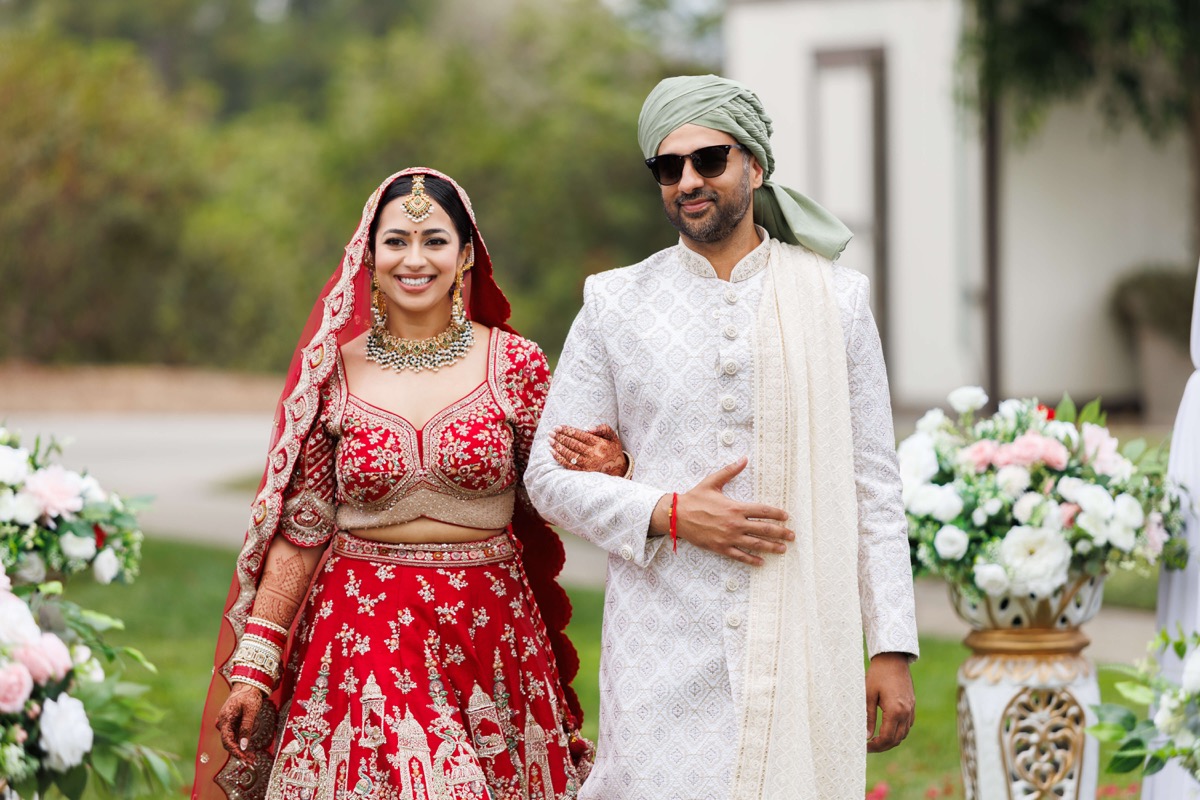
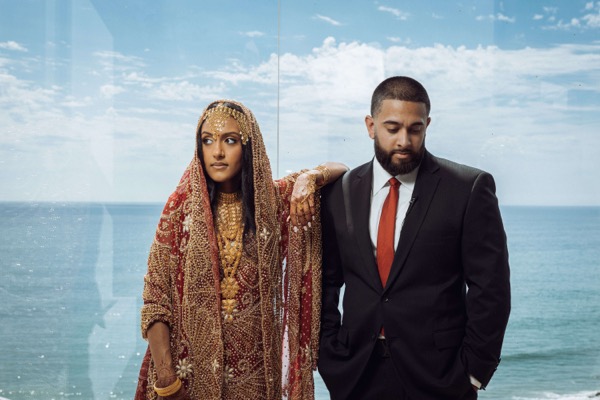
South Asian weddings are unlike anything else in the world. They are multi-day celebrations filled with color, music, emotion, and tradition that most photographers simply do not understand. Whether you are planning a Hindu ceremony, a Sikh Anand Karaj, a Pakistani Nikah, or an interfaith celebration, hiring a photographer who knows these traditions is not optional. It is essential.
We have photographed over 100 South Asian weddings across Southern California, and this guide breaks down everything couples and their families should know about capturing these celebrations the right way.
Why South Asian Weddings Need a Specialist
A typical American wedding lasts a few hours. A South Asian wedding can span two, three, even four days. Each day has its own events, its own energy, its own wardrobe, and its own traditions. A photographer who has only ever shot single-day weddings will be overwhelmed by the pace, the scale, and the sheer number of moments that matter.
South Asian weddings also move fast. The baraat arrives with music and dancing. The ceremony follows rituals that happen in a specific order, sometimes within a tight auspicious time window. Guests crowd in to watch. Lighting changes constantly. If your photographer does not know what is coming next, they will miss it. And there are no second takes.
The Events: What Happens and When
Mehndi
The mehndi ceremony is where henna is applied to the bride's hands and feet, often in intricate designs that take hours to complete. It is usually one of the first events, surrounded by close friends and family. The atmosphere is relaxed and joyful. For photographers, mehndi is about details: the henna patterns, the laughter between the bride and her friends, the colorful decor, and the intimate moments that set the tone for the days ahead.
Sangeet
The sangeet is the music and dance night. Families prepare choreographed performances for weeks. The energy is high, the lighting is dramatic, and the crowd is fully engaged. This is one of the most fun events to photograph because the emotion is genuine and the moments are spontaneous. Capturing dance performances in low, colorful lighting requires a photographer who knows how to work fast without a flash ruining the atmosphere.
Haldi
The haldi ceremony involves turmeric paste being applied to the bride and groom by family members. It is messy, joyful, and deeply intimate. The golden yellow of the turmeric creates vibrant photos, and the candid moments of family members blessing the couple are some of the most emotional images from the entire wedding.
Baraat
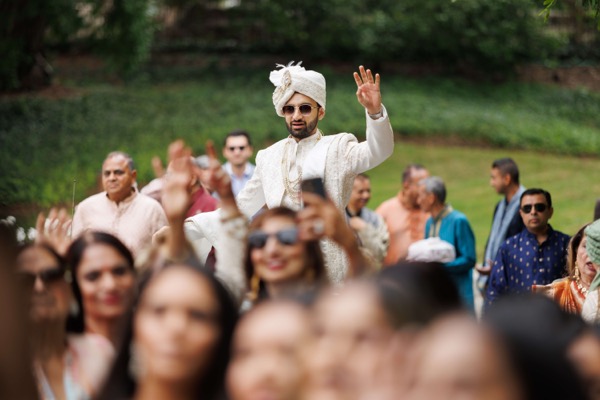
The baraat is the groom's grand entrance, typically on a decorated horse, accompanied by a dhol player, dancing family, and a procession of guests. It is loud, energetic, and chaotic in the best possible way. The baraat is one of the most photographed moments of a South Asian wedding, and it requires a photographer who can move through a crowd, anticipate the action, and capture the groom's expression alongside the energy of the procession.
Hindu Ceremony
Hindu wedding ceremonies take place under a mandap and are led by a pandit. Key moments include the exchange of garlands (jaimala), the circling of the sacred fire (pheras), the tying of the mangalsutra, and the application of sindoor. Each ritual carries deep significance, and the timing can be tight if the family has chosen a specific muhurtham (auspicious time). A photographer needs to know the order of rituals and be in position before each one begins.
Sikh Anand Karaj
The Anand Karaj takes place in a Gurdwara and centers around the Guru Granth Sahib. The couple completes four lavaan (circles) while hymns are sung. The milni, where the families formally meet, and the exchange of garlands are key moments before the ceremony begins. Gurdwaras often have specific rules about where photographers can stand and whether flash is permitted, so experience in these settings matters.
Pakistani Nikah
The Nikah is the Islamic marriage ceremony, typically a more intimate and solemn affair compared to other events. The signing of the marriage contract, the exchange of vows, and the moment the couple sees each other are all critical to document. The rukhsati, where the bride says goodbye to her family, is one of the most emotional moments in any wedding tradition.
Reception
The reception is where everything comes together. Grand entrances, first dances, toasts, cake cutting, and often more performances. South Asian receptions tend to be large, with elaborate decor, stage setups, and lighting. Your photographer needs to capture the scale of the event while still finding the intimate, candid moments that make your celebration yours.
What to Look for in a South Asian Wedding Photographer
They Have Shot Your Specific Tradition Before
Hindu weddings, Sikh weddings, and Pakistani weddings all have different flows. A photographer who has shot dozens of Hindu weddings may still not know the order of a Nikah ceremony. Ask to see full galleries from weddings that match your tradition, not just a few highlight images.
They Offer Multi-Day Packages
If a photographer only offers 8-hour packages, they are not built for South Asian weddings. Your photographer should have packages designed for 2-4 day celebrations, with pricing that reflects the extended coverage without nickel-and-diming you for every extra hour.
They Understand the Pace
South Asian weddings do not follow a neat timeline. Events run late. Ceremonies overlap with cocktail hours. The baraat can last 20 minutes or 90 minutes depending on the energy. Your photographer needs to be flexible, patient, and ready for anything.
They Know How to Handle Large Groups
Family portraits at South Asian weddings can involve 50, 100, even 200 people in a single frame. Your photographer should have experience organizing large group shots efficiently, because you do not want to spend an hour of your wedding day arranging family members.
They Can Work in Challenging Lighting
From the dim, candlelit atmosphere of a sangeet to the bright midday sun of an outdoor baraat to the mixed lighting inside a Gurdwara, South Asian weddings throw every lighting scenario at a photographer. Experience matters here more than gear.
How to Plan Your Photography Timeline
The biggest mistake couples make is underestimating how much time their photographer needs. Here is a general framework for a 3-day South Asian wedding:
- Day 1: Mehndi and Sangeet - 6 to 10 hours of coverage. Mehndi is usually afternoon, sangeet is evening. Build in time for detail shots, getting-ready portraits, and candid coverage of both events.
- Day 2: Haldi and Ceremony - 10 to 14 hours. This is the longest day. Haldi in the morning, couple portraits before or after, ceremony in the afternoon or evening. Factor in travel time between venues if they are different locations.
- Day 3: Reception - 6 to 8 hours. Getting ready, venue details, grand entrance, dinner, performances, dancing. Some couples add a next-day brunch, which is another 2 to 3 hours.
Talk to your photographer early about your specific event schedule. Every South Asian wedding is different, and your timeline should be custom built around your celebrations, not forced into a template.
Why We Love Photographing South Asian Weddings
South Asian weddings are the most visually rich, emotionally intense, and culturally meaningful celebrations we photograph. The colors, the rituals, the fashion, the energy of a dhol player leading a baraat, the quiet tears during a rukhsati, the explosion of joy when the couple completes their pheras. There is nothing else like it.
At Bokeh Weddings, we bring an editorial, fashion-forward approach to South Asian wedding photography. We honor your traditions while creating images that feel modern, timeless, and distinctly yours. We have photographed Hindu, Sikh, Muslim, and interfaith celebrations across Orange County, Los Angeles, San Diego, and beyond.
View our full South Asian wedding photography portfolio or reach out below to start planning your coverage.
More from the Journal
Rancho Las Lomas Wedding | Mikey & Michelle - A culturally rich celebration with Hawaiian and Samoan traditions in Silverado, California.
How to Build Your Wedding Day Timeline - Planning your schedule around multi-day celebrations and ceremonies.
Golden Hour vs. Blue Hour: When to Schedule Your Wedding Portraits - Making the most of natural light on your wedding day.
Best Orange County Wedding Venues for Photography - Venues that work well for South Asian ceremonies.